
When giving a Cultural Awareness Training there is the question: Does Cultural Diversity make you Smile or Cry?
In order to answer this question, it makes sense “breaking” culture/diversity (in this case inter-changeable words) into different layers.
Much like an Onion.
The comparison between Culture and an Onion is the following: “Have you ever cut an onion in your life?”. Most people will say yes! What happens when you cut an onion? Indeed, you start to cry.
Cultural Diversity
The same holds true, more or less for Culture and Diversity. When you go on a holiday for two weeks, say to Spain. You spend there the two weeks either in a Hotel or at a Campground. When you do enjoy your holiday, most of us don’t really get “deep” inside the typical Spanish culture.
Very often this is the same situation when you go for a business trip to a different country. Usually, there is little time to really get to know the “other” culture.
Longer
However, when you go on a longer trip, say something like 2 months or longer, or when you get married to someone from another culture, you get much “deeper” into that specific culture than you would if it were only a vacation.
Schematic
To put the above in a picture might make good sense.
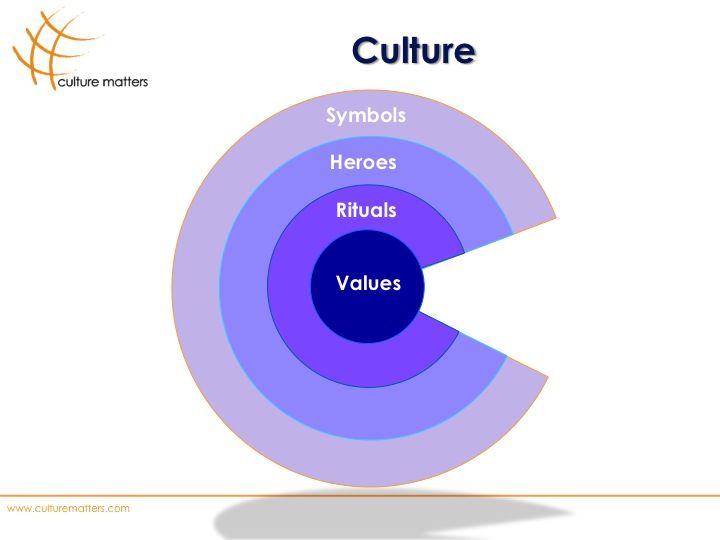
At the center, there are our Values. Our Values are difficult to define just like that. If I would ask you “What are your Values?“. What would you say? Most people need to think deeply. But… we do have Values! Our Values come out when something happens that we do not agree with.
For example, you’re waiting to park in a parking slot that is about to become vacant. And just when you’re ready to park, someone else slips in your slot. THAT’S NOT OK! How do you know? Well, your values tell you this.
From the Outside In
Symbols
Examples of cultural diversity symbols are:
- A Flag
- Buildings; office buildings; buildings of worship
- Currencies; Yen, Dollar, Euro
- Dress code; does a culture dress formal, or more informal? Among the Dutch, Germans, and Belgians, the Dutch typically dress the least formally; the Dress code is also a cultural symbol within an organization: the corporate culture.
- etc…
Heroes
The definition of a Hero in this context is: “The Personification of what is Good or Bad in society”. So on one side, there are Heroes, and on the other side, there are Anti-Heroes. What are your Heroes?
Examples of Heroes depend on the culture you ask:
- Americans: Presidents or Sports and Movie Heroes
- Indians: Mahatma Gandhi (always!)
- French: Charles de Gaulle
- Dutch: the Dutch have no Heroes (really)
- Within organizations you can think of the Founding fathers, people making promotion(s), etc.
- etc…
Rituals
Every culture has an enormous number of Rituals. In our own culture, we hardly see them anymore. We do see the Rituals of other cultures when observing them.
Examples of Rituals are:
- Christmas
- Birthdays
- Tax-day
- Birth & Death
- Company meetings
- Company workshops
- Hiring & Firing of personnel
- etc…
Combined
The combination of Symbols, Heroes (and what they stand for), and Rituals make up the “Observable” part of a Culture. At the core, there are our Values. We cannot see our Values, but we do have them!
Another article that talks about a cultural awareness definition can be found here.
Which examples did I miss? Please add them below.
Get a Taste of How Chris Presents, Watch his TEDx Talk
 Call Direct: +32476524957
 Call Direct: +32476524957
European Office (Paris) Whatsapp: +32476524957
 European Office (Paris) Whatsapp: +32476524957
The Americas (USA; Atlanta, GA; también en Español): +1 678 301 8369
Book a 20-minute strategy call
If you want more details, fill in the form below
No obligation. Chris will personally respond to discuss your event, audience, and objectives.

His education is in Organisational Psychology and he has lived in the USA, the Netherlands, and currently lives in Belgium.
Chris Smit
- 204 Cultural Differences and Architecture with Kevin Kenon - 29 September 2026
- 203 Cultural Differences and Corporate Coaching with Nic Woodthorpe-Wright - 15 September 2026
- 202 Leadership and Culture with Diane Demetre - 1 September 2026
Thanks Chris. I would say it is a combination of both; probably at first you smile (or are attonished), when encountered many times, is when you then cry. Cristina
Def. a combination of both. Cross cultural training is a great and imperative type of training in business today however, ensuring you are presenting yourself properly and following all the new cultural guidelines could prove overwhelming! (esp. if they contradict your own)