
In this article I will address the following topics about masculinity and femininity:
- What are masculinity and femininity?
- Define masculine
- Define femininity
- Masculine and feminine gender examples
Definition of Masculinity and Femininity
Let’s first start with a definition of masculinity and femininity:
“Masculinity and femininity, from a cultural point of view and not from a gender point of view, give an indication of the direction of motivation. Whether this is goal oriented (=masculine) or whether this is process oriented (=feminine)”
If you do a search on the Internet for “what is masculinity and femininity” there are of course thousands of results. However, most of these results consider the gender association that is so often made when you talk about this cultural dimension.
I will give some masculine and feminine gender examples, but this will not be the focus point. Because the name given to this dimension is misleading to many (masculine) cultures (read the part on masculine and feminine gender examples).
What’s Wrong With Masculinity and Femininity?
The main problem lies in the association that many people have or make when they hear these two words; often they are immediately associated with gender; the woman man comparison. And that was never the intention.
A better name for this cultural dimension could be Process versus Goal orientation. But most academia and most of the Internet search results still focus on the initial name.
In the rest of this article, I will do the same. Just remember that you can substitute masculinity with Goal orientation and femininity with Process orientation.
In my own experience does the USA have the biggest conceptual issues with the name of this dimension.
At a certain time when I was giving a workshop in Boston MA, someone walked up to me tell me that I couldn’t use these terms because they were discriminating. Of course, that was never my intention. The solution I found was either using the words “Goal Orientation” or “Tough” for masculine cultures and “Process” or “Tender” for feminine cultures.
Define Masculine
To define masculinity, using the word “Goal” makes more sense than using the word “Tough“. Another way to define masculinity is: “Winning & decisiveness are important in society”.
Examples and characteristics that define masculinity are:
- Winning is good, and gets you rewarded: usually, the best indicator for performing or performance is money, because it is a measurable quantity. For that reason being rewarded for one’s performance is more prevalent in masculine countries than in feminine countries.
- Standing or status is important. This is “Acquired” status. In other words, if you work hard enough, you can achieve this form of status (as opposed to “Ascribed” status, which has to do with Hierarchy). When you work hard you will be rewarded for your performance which will give you the status you desire.
- Competition: competing is good and is considered fair play; or a chance to show how good you are. Even competition amongst colleagues in the same organization or department is seen as fair play.
- Admiration for the winner: the successful achiever gets the credits and is being admired for what she has done and achieved.
Examples of Masculinity Countries
- Japan (highest scoring country in the world!)
- USA (not surprisingly maybe)
- The UK
- Italy
- Nigeria
To find a complete overview of all the countries and their respective score on this dimension and other cultural dimensions please go here.
Define Femininity
When we define femininity the word “Tender” makes good sense. However, a better way to define femininity is “Process orientation and consensus“.
Below you can find some examples and characteristics that define femininity:
- Sticking your head out is not appreciated (socially, nor materially): in other words being better than others does not get you more money and people will not like you more.
- Equal: don’t think you are anyone, just because you think you are. In the Nordic countries, there is even a specific “Law of Jante“. It says something like: don’t think you are anyone, that you will become anyone or that you’re better than anyone…
- Consensus: rather than being decisive, people prefer the process of reaching consensus (which is something different than reaching a compromise; with a compromise both parties don’t get what they want, while with a consensus agreement people can go for the “third option“)
- Sympathy for the loser: or sympathy for the underdog; the less successful in society deserve a chance and should be helped.
Examples of Feminine Countries

- The Netherlands
- Nordic Countries
- Iceland
- Chile
- Thailand
To find a complete overview of all the countries and their respective score on this dimension and other cultural dimensions please go here.
Masculine and Feminine Gender Examples
It is not totally untrue that this dimension is not related to gender differences.
It is just true that when people define masculinity or define femininity they immediately think of the gender differences.
In one given country you will find that indeed men are more masculine than women. So in the highest-scoring country, Japan, the men would score more masculine than the Japanese women.
However, we’re talking about cultural differences. And in particular differences between countries or cultures. Not within one country (then you would simply refer to gender differences and call it gender differences too).
What we need to do is compare one country with another. So if you take the highest-scoring country, Japan, and compare this with the lowest scoring country (the most feminine), Sweden, you would find that Japanese men are significantly more masculine than Swedish men. And the same holds true for women; Japanese women are significantly more masculine than Swedish women.
Another way of looking at the masculine and feminine gender examples is a phenomenon called “role overlap“. To what extent does society accept that men do what women traditionally should do and vice versa.
In feminine cultures, this role overlap is much bigger than in more masculine cultures.
Another masculine and feminine gender example can be put in a question:
“Being Employee of the Month; Is this a Reward or a Punishment?“
The answer to the above question depends a great deal on your cultural background. There are cultures that would answer with a definite YES, others with a NO (and there are the in-betweens too of course).
And in more masculine countries women as much as men are motivated by being the employee of the month. Whereas in feminine countries neither would care much about it.
Gender Differences and Social Media
Below is an image that displays how English-speaking men and women differ in the use of language that they use on social media.
So within one culture, you will see gender differences between men and women. However, these are so-called intrA-cultural differences and not intER-cultural differences.
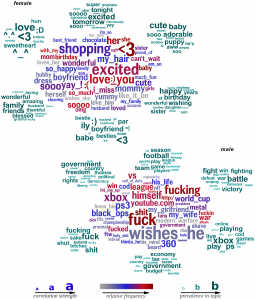
Click to enlarge
Source: Wikipedia
Marketing
This Masculinity and Femininity dimension of culture is often considered as the Marketing dimension. Many of the commercials we see are either very (over the top) Feminine or very (over the top) Masculine.
Below is an example:
Comments? Leave them at the end of this post
An article about gender differences can be found here.
An article about culture and personality can be found here.
An article on how different genders use social media can be found here.
More examples of masculinity and femininity can be found here.
Get a Taste of How Chris Presents, Watch his TEDx Talk
 Call Direct: +32476524957
 Call Direct: +32476524957
European Office (Paris) Whatsapp: +32476524957
 European Office (Paris) Whatsapp: +32476524957
The Americas (USA; Atlanta, GA; también en Español): +1 678 301 8369
Book a 20-minute strategy call
If you want more details, fill in the form below
No obligation. Chris will personally respond to discuss your event, audience, and objectives.

His education is in Organisational Psychology and he has lived in the USA, the Netherlands, and currently lives in Belgium.
Chris Smit
- 205 Cultural Differences and the Levant with Dr. Hussein Rifai - 13 October 2026
- 204 Cultural Differences and Architecture with Kevin Kennon - 29 September 2026
- 203 Cultural Differences and Corporate Coaching with Nic Woodthorpe-Wright - 15 September 2026
Are feminine countries more likely to have women leaders?
Hi Barbara,
Thanks for your comments.
No, feminine cultures are not more likely to have women leaders.
Think of Masculine countries like the UK, India and to a lesser extent Brazil.
Hope that helps.
Kind regards,
Chris
Hi Chris
Can you explain why feminine cultures are not more likely to have women leaders?
Thanks
Ryan
Hi Ryan,
Thanks for your comment.
You have a point here. But I’m not sure if that is/was a point with the central meaning of this dimension.
For me this more has to do with the role overlap in society: a man can do what a women can do and vice versa.
Of course, leadership is part of that as well. But… a lot of women still choose to stay home and have (men simply can’t do this) and raise their children.
Most, if not all, societies are still traditional like this.
Another thing to consider is that the name “Masculinity & Femininity” always sparks the gender discussion. I believe that this was never the intention of Hofstede.
Therefore I really dislike this name for this dimension and hence, I”ve renamed it to Goal Orientation and Process Orientation. And with that, I can avoid this unintended gender discussion.
Hope this helps.
can you please tell me two ways how the rigid definitions of masculinity and femininity make individuals who do not conform to these traits or characteristics typically associated with being male or female, feel isolated with society
Hi Jaiden,
Thank you for your comments.
You’re touching on a pretty sensitive subject.
Let me see if I can add my two cents:
1. When we’re talking about culture (in our context) we’re talking about groups of people. Not individuals. We’re talking about groups of people or “general trends in society”.
2. The two terms Masculinity and Femininity, chosen by the late professor Geert Hofstede, never wanted to initiate the idea of gender differences. Although when you hear those two terms almost everyone thinks of this.
For that reason, I’m using Goal Orientation (replaces Hofstede’s term Masculinity) and/versus Process Orientation (which replaces Hofstede’s Femininity).
Whenever I present this 3rd dimension of culture like this, I never end up in the “Gender” discussion, which I know was never Hofstede’s intention.
Hope this helps.