
Why Global Talent Sourcing from Other Countries?
[4-min read]
With the constant and rapidly changing technology around us, there seems to be more and more of a need for specialized, usually technical personnel. The flow or sourcing of global talent (read more here) seems to be geographically from East to West and to a lesser extent from South (Latin America) to North (USA).
The simple reason for this global talent sourcing is that in most Western countries, there simply aren’t enough people/talent to fill the demand.
Typical countries where global talent comes from are:
- India
- Turkey
- Ukraine
- Russia
- Mexico
It is mostly IT/Tech companies and Multinationals who have the need and resources to get personnel from other countries. But how do these companies best deal with the newly recruited people in such a way that both the company and the recruited employee assimilate well (and costly failure is avoided)?
Why Is Cultural Onboarding So Important?

Getting people from one country to the other is not so difficult. But when it comes to professional global talent sourcing, cultural onboarding is really important.
What is cultural onboarding? Ideally, it is part of the “induction program” that a newcomer goes through. The usual things are an introduction to new colleagues, a talk with the new boss, and arranging logistics, such as housing, banking, laptop, phone, etc.
What often isn’t part of this induction program is intercultural management. The question then is: What are the overall cultural differences between the country of destination and the country of origin? Many times, these differences are very significant!
Dealing with Culture Shock
A phenomenon that pretty much every individual goes through is culture shock.
The initial “honeymoon period” is over, and the newly globally sourced talent is wondering what he or she is doing in their host country.
The emotional challenges that newcomers face (from mild to severe depression!) are often underestimated by the host country. The process of culture shock generally looks like this (see image below).
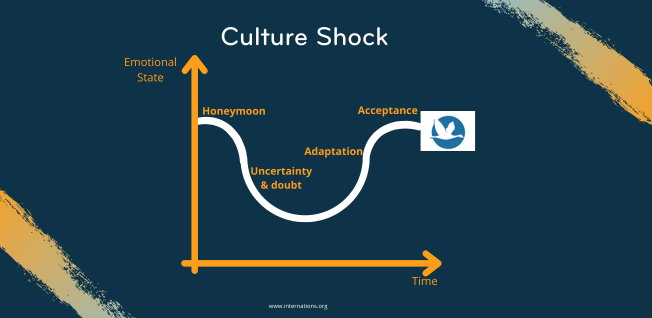
[source: https://www.internations.org/magazine/the-4-stages-of-culture-shock-40101]Cultural onboarding and making yourself (!) and the newcomer (s) culturally competent can help tremendously in retaining personnel. In addition, if the newcomer comes with a partner/family, it is often the partner who ultimately decides to stay or go back home. And a failed expatriation is very expensive; see the example below.
Example*:
And this is an example pertaining only to one (!) individual…
|
It is NOT about the Legal or Accounting Stuff
There are plenty of companies that will help global companies find globally sourced talent. Often their focus is on the legal side (visa/permits, etc.) and the accounting part (salary, benefits, etc.).
We state that, though this is important, it is not THE most important item to overcome. Legal and accounting issues are easily outsourced to other professionals or could even be handled within the host company/country.
What you cannot outsource is cultural competence. On both sides: You (and your personnel) should be culturally competent, and the newcomer should be culturally competent. It is a skill you can learn.
Reading about Swimming versus Actual Swimming
And here is where we come in: We can make you and your globally sourced talent culturally competent.
The analogy is this: How will you learn to swim if you only read about swimming as opposed to getting into the water?
Again, cultural competence is a crucial skill that you must (yes, must) learn to stay ahead in the game and of your competition.
If you’re interested in listening to our podcast about this topic, please go here.
An article on employee motivation can be found here.
Want to know more: https://culturematters.com/187-building-a-collaborative-global-culture-with-jim-fielding/
Want to know more: https://culturematters.com/culture-and-real-estate-with-julie-condliffe/
Get a Taste of How Chris Presents, Watch his TEDx Talk
 Call Direct: +32476524957
 Call Direct: +32476524957
European Office (Paris) Whatsapp: +32476524957
 European Office (Paris) Whatsapp: +32476524957
The Americas (USA; Atlanta, GA; también en Español): +1 678 301 8369
Book a 20-minute strategy call
If you want more details, fill in the form below
No obligation. Chris will personally respond to discuss your event, audience, and objectives.

His education is in Organisational Psychology and he has lived in the USA, the Netherlands, and currently lives in Belgium.
Chris Smit
- 205 Cultural Differences and the Levant with Dr. Hussein Rifai - 13 October 2026
- 204 Cultural Differences and Architecture with Kevin Kenon - 29 September 2026
- 203 Cultural Differences and Corporate Coaching with Nic Woodthorpe-Wright - 15 September 2026