
Gender Roles in Society
Different cultures deal differently with gender roles in society.
There are so-called masculine cultures and there are feminine cultures.
The downside of these two names (masculine and feminine) is that there usually is an immediate association with gender.
In the original research work of Geert Hofstede, the intention was never there to trigger a strong association with gender-related issues in society.
But evidently, these associations are there and for a bigger part, they are not related.
So when it comes to culture and gender the words “masculinity” and “femininity” do not point to gender differences.
Culture and Gender Roles in Society
The cultural dimension Masculinity – Femininity says something about the expected behavior of men and women in any given society.
To simplify it: in high-scoring cultures, there seems to be relatively little role overlap; men are supposed to provide for their families, be the head of the family, and do manly tasks like taking the garbage out.
While in more feminine societies, there is more role overlap; here it is OK if a woman earns more than a man and the “stay at home dad” is more accepted than in masculine societies.
So when it comes to culture and gender this would be the closest link to gender differences and gender roles in society.
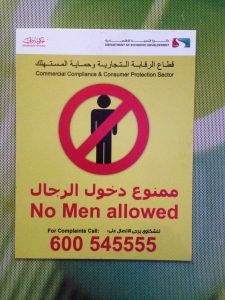
Take a look at the image below. This picture was taken during one of my trips to the Middle East (or read this article specifically about Dubai). A sign like that would be impossible in a feminine country like Sweden, for instance.
What are the Gender Roles in Society Within one Culture?
In any country in the world, you will find so-called IntrA-cultural differences; differences within one country, say the American East Coast and the American West Coast. Or the differences between the North and the South of Spain.
Differences within one country are called IntrA-cultural differences.
Differences between countries are called IntER-cultural differences.
There are definitely differences in gender roles within one country. In other words, American women will be less masculine than their male countrymen.
The same will be true for the most feminine country in the world, Sweden; also there will men be more masculine than women.
A clear example is the following “Word Cloud“, which illustrates the use of words in Social Media of English-speaking men and women.
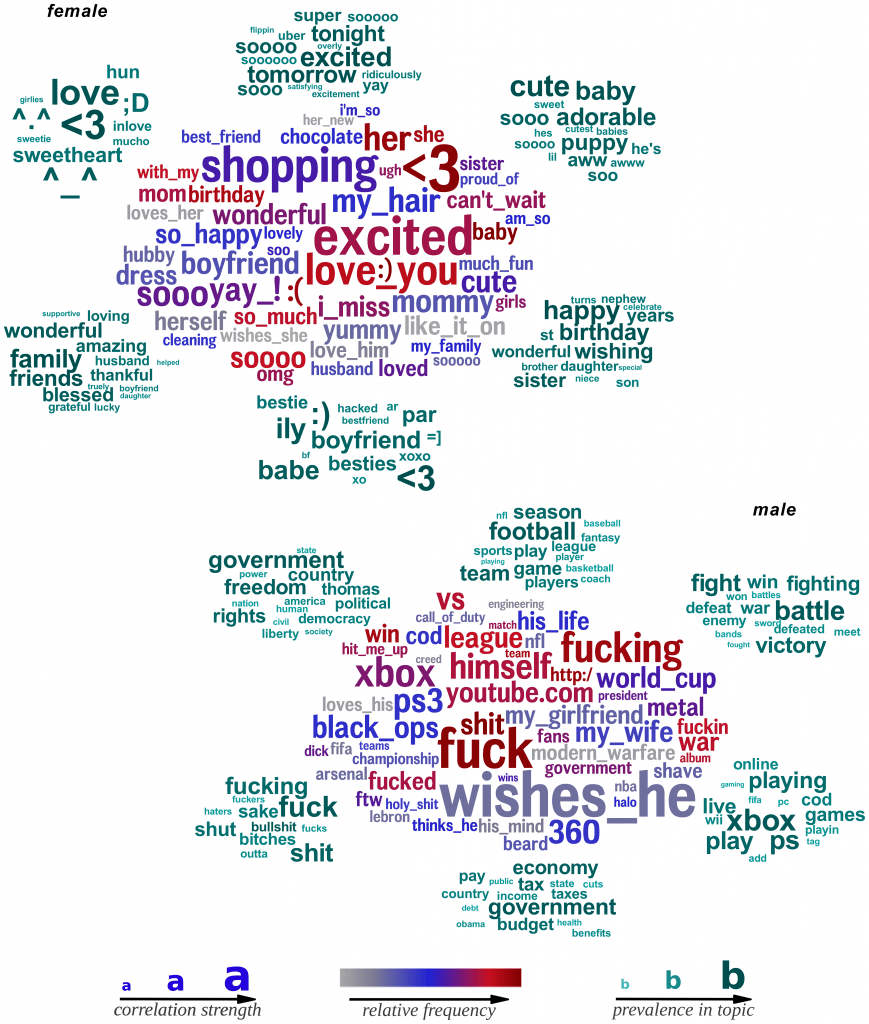
What you can clearly see is that English-speaking men use more forceful language than English-speaking women.
However, when you compare English-speaking women with Swedish women, you will still see that there is a big significant difference is between those two countries/groups when you look at the scores of these countries on this masculinity and femininity dimension.
If you’re interested in learning more why not get one of these books?


Get a Taste of How Chris Presents, Watch his TEDx Talk
 Call Direct: +32476524957
 Call Direct: +32476524957
European Office (Paris) Whatsapp: +32476524957
 European Office (Paris) Whatsapp: +32476524957
The Americas (USA; Atlanta, GA; también en Español): +1 678 301 8369
Book a 20-minute strategy call
If you want more details, fill in the form below
No obligation. Chris will personally respond to discuss your event, audience, and objectives.

His education is in Organisational Psychology and he has lived in the USA, the Netherlands, and currently lives in Belgium.
Chris Smit
- 205 Cultural Differences and the Levant with Dr. Hussein Rifai - 13 October 2026
- 204 Cultural Differences and Architecture with Kevin Kenon - 29 September 2026
- 203 Cultural Differences and Corporate Coaching with Nic Woodthorpe-Wright - 15 September 2026
“However, when you compare English-speaking women with Swedish women, you will still see that there is a big significant difference is between those two countries/groups when you look at the scores of these countries on this masculinity and femininity dimension.”
Okay so what is that difference?
Hi Justin,
Thank you for your comment.
What I’m talking about is comparing apples with apples and pears with pears.
In this case, comparing Britsh women with Swedish women and British men with Swedish men.
What differences will you see (and these are examples):
British women will work more part-time than their male peers; Swedish women will even (!) work more part-time than British women.
There will be more Swedish women who earn more than their husbands than there will be in the UK (there, men will earn more than women).
British women are less career driven than British men, but British women will be more career driven than Swedish women.
Etc.
Hope it makes sense.
Hi Chris,
Your article is extremely helpful, thank you. I am researching gender roles cross-culturally. I would like to cite your work, but cannot find the publisher of your content. Any feedback would be much appreciated. The paper is for an international business class and centers on Hofstede’s cultural dimension theory of Masculinity and Femininity.
Again, thank you for your time and response.
Hi Denise,
Thank you for your comment and compliment.
I’m not sure what you mean with “finding the source of my content“?
Feel free to use my site as a reference.
If you do use my work, I would appreciate you’d put a link to my site in any of your work.
Otherwise, there is always Google…
Kind regards,
Chris
Hi! I am a student, and I am doing an essay about how gender and culture relate to each other, and your article can be beneficial for me, and I am a little unsure because I can’t find the article you used to support your idea. But anyway, I liked the whole idea of your article, and I hope you would interact with this comment.
Hi Ronaldo,
Thank you for your comment. Not sure how and with what I can help you?